

Fort McKinney, located on Powder River east of Kaycee in 1876, was moved to Clear Creek in Buffalo in 1878. It was named after 29-year-old Lt. John A. McKinney, who was killed at the Dull Knife Battle on November 25, 1876. He was the only officer killed that day, and his youth and bravery led to Fort Reno being renamed in his honor. More on the history: Fort Reno did previously exist. The abandoned (1868) Fort Reno was reopened in 1876 and moved downstream, then renamed Cantonment Reno, and then Depot McKinney, before being moved to Buffalo and called Fort McKinney.
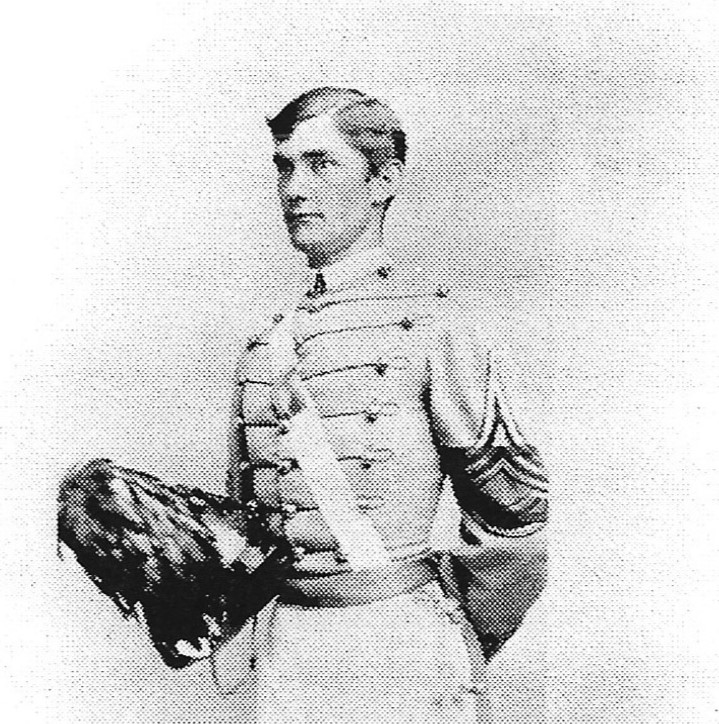
Lt. John A. McKinney
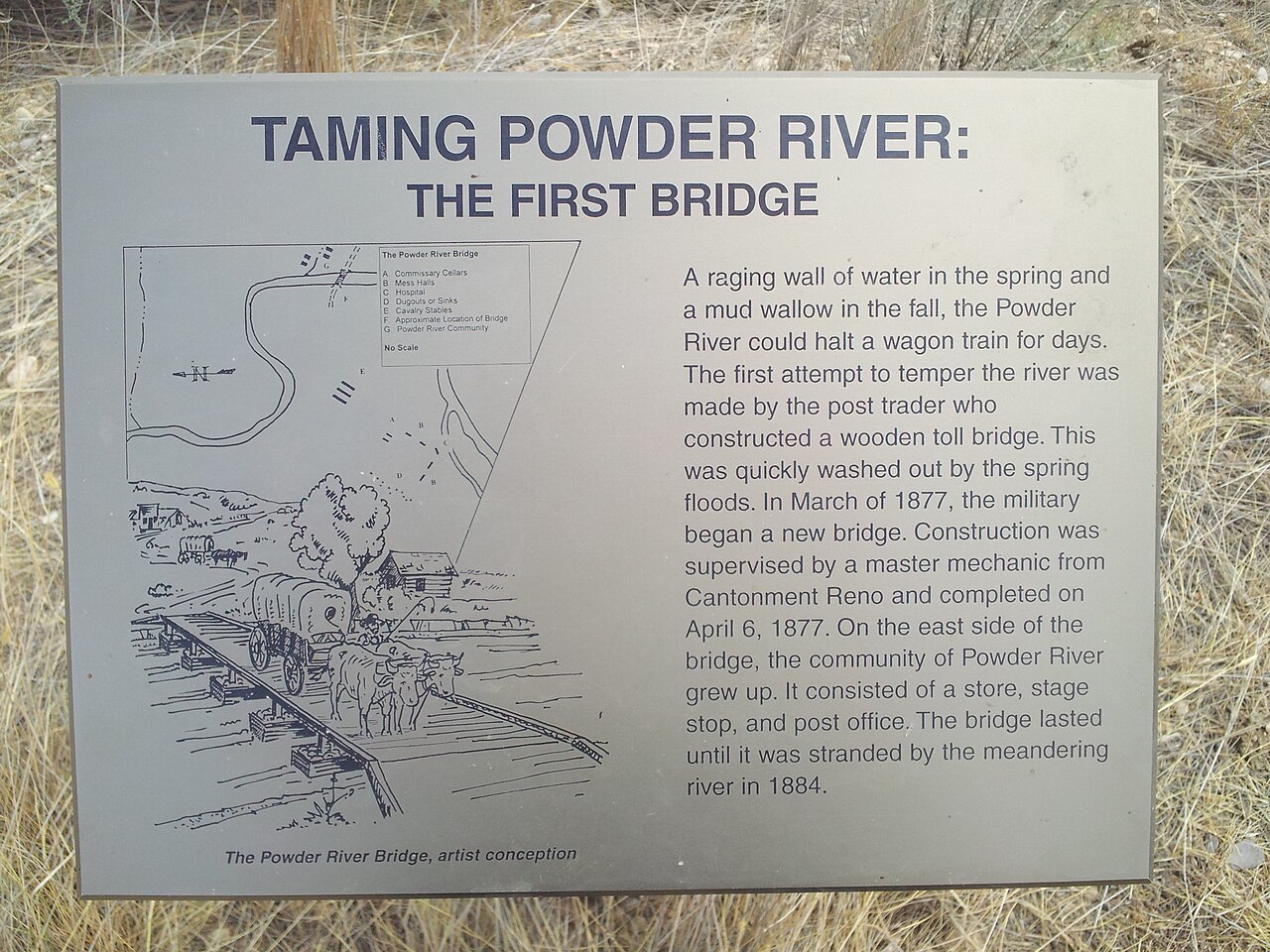
The Powder River Crossing, is an abandoned settlement
located on the east bank of the Powder River in southeast Johnson County
about twenty-four miles east of Kaycee, Wyoming. It developed after a
wooden toll bridge was built across the Powder River in 1877, at a site
that was originally used as a ford. With crossing secured, a settlement
developed here in the late 19th century, incorporating a stage stop on
the Bozeman Trail. The site is notable for having well-preserved wagon
ruts from the pioneer era.
Cantonment Reno
Powder River
Crossing was a civilian settlement that grew up on the Bozeman Trail,
across the Powder River from Cantonment Reno. Cantonment Reno was
established in late 1876, three miles upstream from the site of Fort
Reno, a fort that was established in 1865 and abandoned in 1868 under
the terms of the Fort Laramie Treaty of 1868.
By 1878, Cantonment
Reno was experiencing a shortage of lumber, forage and water. The army
decided to relocate the fort to Fort McKinney, about 45 miles northwest
near the present-day site of Buffalo, Wyoming. By the end of 1878, all
the soldiers were gone except for a small detail who looked after the
abandoned buildings and ran the telegraph station.
Stage Stop
The army built a military road and telegraph line along the Bozeman
Trail in 1877 and 1878. Soldiers from Cantonment Reno completed a wooden
bridge at the Powder River Crossing on April 6, 1877.
In April
1979, the Patrick Brothers Stage Line began thrice weekly regular
service between Fort Fetterman and Etchetah, Montana on the Bozeman
Trail. Powder River Crossing was the fifth stage stop after Fort
Fetterman. On May 13, 1879, the army allowed the old sutler's store and
one of the cavalry stables from Cantonment Reno to be used as a store
and eating house at Powder River Crossing.[4] An English traveler stayed
at the store on August 30, 1880, and left a description:
"This is
a deserted Fort....The log huts, built in a large square, are still
standing. Frewen's store is in one of them, and there are two or three
bedrooms there, rather rough and ready, one of which I secured....I was
very tired towards night, and turned in early-no sheets-only a pair of
blankets to get between, but I was soon asleep notwithstanding."
In January 1880, the Rock Creek Stage Company moved another log cavalry
stable from the old cantonment to a point east of the Powder River along
the Dry Fork. They also built several other buildings including a new
stage stop. The stage station was eventually made up of a large, long
building (store, saloon, and living quarters in one) along with stables,
a blacksmith shop, and numerous old dugout cabins. The amenities
included fresh horses, tobacco, whiskey, and prostitutes. From 1882 to
1891, William P. Hathaway ran the store and saloon which was located
directly east of the dry gulch at the end of the little patch of
timber."
Amanda and Horace Brown ran the stage stop at Powder
River Crossing from 1884 until 1887. Her memoirs appeared in the October
1958 issue of Colorado Magazine:
"We made good money, but I sure
worked myself down. I cooked for all the way from ten to forty people,
did all my washing, cleaned the rooms, and waited on people. We kept the
stage people. I always had to be ready for a stage full, and sometimes
it was only the drivers. There were all the different people which make
up a new country traveling on the road - ranchmen, cowboys, gamblers,
horse thieves, and occasionally stage robbers."
According to
Brown, a small community grew up around the stage station, and the iron
bridge that was built in 1883. There were never more than four families
at Powder River Crossing, but the amenities includes a store, a post
office, and a saloon. When the Burlington Railroad reached Clearmont,
Wyoming in 1892, the stage line was no longer needed.
Abandonment
The post office at Powder River was established on May 22, 1879 with
John Livingston as the first postmaster. In 1881, Henry Winter ("Hard
Winter") Davis, established the Spectacle Ranch near the present site of
Sussex, Wyoming. The post office at Powder River Crossing moved to the
Davis ranch on October 18, 1895. The road that ran down the Dry Fork was
rerouted to cross the Powder River at Sussex, and it eventually became
Wyoming Highway 192. In 1914, a new bridge and post office were built at
Sussex (Sussex Post Office and Store), and this spelled the end of
Powder River Crossing.
Present Status
The area at Powder River
Crossing was never homesteaded, and it is owned by the Wyoming Office of
State Lands and Investments, an agency of the State of Wyoming. There is
a wide dispersal of wagon ruts from the Bozeman Trail near the mouth of
the Dry Fork tributary. Near the ruts, marked by a grove of cottonwood
trees, is the former location of the Powder River Station and the eating
establishment run by Horace Brown.
If you have questions, contributions, or problems with this site, email:
Coordinator - Rebecca Maloney
State Coordinator: Rebecca Maloney
Asst. State Coordinator: Bob Jenkins
If you have questions or problems with this site, email the County Coordinator. Please to not ask for specfic research on your family. I am unable to do your personal research. I do not live in Wyoming and do not have access to additional records.