

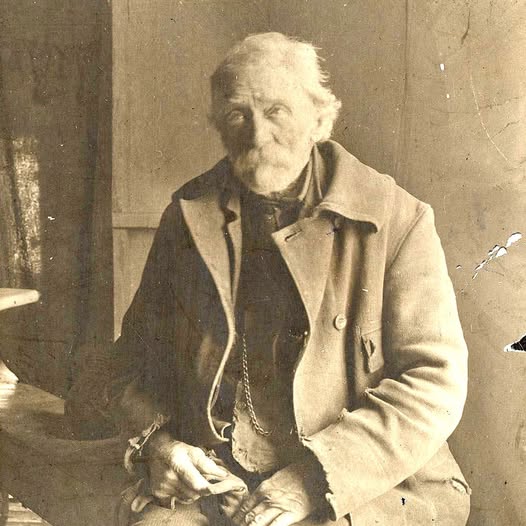
Sam Stringer (1830-1905) led a remarkable life before he even became
a mail carrier in this area as a senior citizen. He fought the Seminoles
in Florida, for which he received a pension later in life, and was a
teamster in the Confederate Army (where in one battle he lost his entire
outfit) before coming to Johnson County as a teamster with Henry B.
Carrington in 1866. He missed being massacred with the wood-cutting
party at the Fetterman Fight because his wagon was being repaired at the
time. As a mail carrier, he transported mail from Buffalo through
Mayoworth and over the mountain to Ten Sleep and back. One on of these
trips a winter storm stranded him in the mountains, and he was forced to
eat tallow candles and pitch from trees to survive. He managed to make
it back and after recovering resumed his mail duties for many years.
Source: Listen Closely Volume II
Annals of Wyoming, Vol. 11 January, 1939 No. 1
September,
1935.
It might be permissible to mention a few things in regard
to Sam Stringer's past history, a part of which he told me over forty
years ago.
When a young man he was a teamster in the Confederate
Army and at the Wilson Creek battle near Springfield, Missouri, he lost
his entire outfit. He came as a teamster with General Carrington in 1866
to where Fort Phillip Kearney was established in what is now Johnson
County, Wyoming, in 1866. He told me he would have been with the wood
train when it was attacked by the Indians had it not been that his wagon
was at the Fort at the time for repairs. He was one of the men from the
Fort who assisted in bringing in the bodies of the dead soldiers killed
by the Indians at what is now known as Massacre Hill, where Fetterman
with seventy-eight soldiers and two civilians were killed December 21st,
1866.
Mr. Stringer drew a small pension for fighting Seminole
Indians in Florida as a volunteer.
He was also with General
George A. Custer, as a teamster, in 1868 when Custer left Camp Supply,
December 7th, 1868, with about fifteen hundred soldiers to fight
Indians. Custer located a large camp of Cheyennes with Medicine Arrow a?
principal Chief, on Sweetwater, a tributary of Red River, December 17th.
Custer was trying to locate two white women who had been captured by the
Cheyennes while raiding Salina, Soloman, and Republican Valleys in
Kansas during the summer and fall of 1868. One of the women, 19 years
old, was Mrs. James S. Morgan (formerly Miss Brewster) who was a bride
of less than a month. The other was a Miss Sarah White, 18 years old.
When Custer ascertained that these two women were in this camp and
knowing what their fate might be if he attacked the camp, after meeting
some of the Indians with a flag of truce, he used strategy to get
possession of the women. After four or five days of dickering and
holding some of the Chiefs as hostage for their safe delivery, he
succeeded in having the women turned over to him. Daniel A. Brewster, a
brother of Mrs. Morgan, was with Custer and the first one to meet his
sister. Mr. Stringer was with Custer at this time and also the late W.
G. Angus of Buffalo, Wyoming. Each of these men related to me some of
the happenings of this particular event. I was informed that the bands
played "Home, Sweet Home" while these two women were approaching the
soldiers, and Mr. Angus said he thought it was the sweetest music he had
ever listened to. Mr. Stringer gave me rather a vivid account of this
entire affair. On their departure for their former home the soldiers
took up a collection and presented to the two women, over seven hundred
dollars.
I might say, also in conclusion, that Mr. Stringer at
one time had several mule teams and did construction work in railroad
building, and at one time was robbed of several thou- sand dollars.
Mr. Stringer worked for the Government as a civilian teamster for
several years. He also carried the U. S. Mail for a number of years,
over various routes, and at the time of his death he had the mail
contract from Buffalo, Wyoming, to Sussex, Wyoming.
A. L. Brock,
Buffalo, Wyo.
Annals of Wyoming, Vol. 11 January, 1939 No. 1
EARLY EXPERIENCES OF A MAIL CARRIER
By A. L. Brock, of Buffalo,
Wyoming
A. L. Brock, Buffalo,
Wyoming,
During the latter part of March 1892 Sam Stringer was
carrying the U. S. Mail from Buffalo via Mayoworth across the Big Horn
Mountains to Ten Sleep, Wyoming. The snow at that time was rather deep
on the mountains between Mayo- worth and Ten Sleep. While Mr. Stringer
used only one team of mules from Buffalo to Mayoworth, he used four to
carry the mail over the mountains when the snow was deep.
After
leaving Mayoworth and reaching his cabin on the head of Pass Creek on
the mountains, he left his mules tied to a light wagon and continued on
snow shoes to Ten Sleep pulling a toboggan loaded with the mail. After
an absence of seven days from Mayoworth, W. W. Morgareidge, J. R.
Morgareidge, W. S. Jones and myself started out to ascertain why he had
not returned. After going as far as was possible on the mountains with
horses, the writer looked after the horses while the other three men
went on snow shoes to the cabin on Pass Creek where they found the mules
tied to the wagon still wearing the harness. The mules had succeeded in
reaching the hay and grain on the wagon and had gnawed quite a bit of
the wagon box including the hickory wagon bows.
The three men
spent the night at the cabin, while I stayed over night with the horses,
three miles back on the trail. During the night the wind blew my camp
fire away and I put a saddle and blanket on one of the horses, which was
accustomed to being in the stable, to keep him from getting so cold. I
might add that I passed a very disagreeable night as care- taker of the
horses.
The three men, after their night at the cabin, turned the
mules loose and brought them to where they could get feed and then came
to where I was with the saddle horses. We concluded that Mr. Stringer
had perished and was under some snow drift. We then returned home, this
being the ninth day since Mr. Stringer had left Mayoworth.
We
learned later that Mr. Stringer, on the return trip from Ten Sleep broke
one of his snow shoes, became very sick and was about three miles from
the cabin on the night that the three men stayed there. He crawled on
his hands and knees most of the way from there to his cabin as he was
sick and had only one snow shoe. When he reached the cabin he didn't
have any matches and in order to start a fire he picked his handkerchief
to pieces and made a pile of lint and then covered this with fine
shavings and shot into it with his six shooter.
After staying
there several days while recovering from his illness and eating what
provisions he had, including tallow candles, he started for Mayoworth
with the mail sack. When he reached the point where he found the mules
he took some cord from his snow shoes, tied the mail sack on one of the
mules and tried to bring them with him. but the mule got away and he
could not catch him again.
Mr. Stringer was so very weak that he
started on for Mayoworth leaving the mail sack on the mule. Soon after
leaving the mules a severe storm struck him. He went into the timber and
while sleeping by the fire his clothing caught and he burned a large
hole in the back of his coat. He ate pitch from the trees during the
three days storm. At one time a gray wolf was following him and kept
getting closer and closer. Stringer wanted the wolf for food. When it
approached as near as he thought safe he drew down on it with his trusty
six shooter, fired, but missed the wolf, and it ran away. Stringer
stated that he felt so badly that he wept. He then continued his journey
and finally reached what was at that time the Cochie Ranch, about four
miles west of Mayoworth, in a very weak condition and his feet badly
frozen. Cochie saturated his feet with coal oil which probably saved
them from having to be amputated later.
Mr. Stringer told me that
while he was sick and delirious he could hear people talking in Buffalo
and recognize their voices.
George B. McClellan and Tom O'Day
came across the mountains on snow shoes and seeing the mule with the
mail sack on him, took the sack and brought it in with them. The mules
were later brought in by Jerry Morgan. The rivets on the leather mail
pouch had made sores on the mule, causing the hair to be white when
healed.
After the harrowing experiences of Mr. Stringer, it was
found that the mail sack contained but one lonely letter.
It is
commendable as well as an example of the loyalty and trustworthiness in
trying to keep the mail sack with him when he thought he was facing
possible death from sickness and hunger and exposure.
After
recovering from his serious adventure he again resumed his duties as
mail carrier. He had carried U. S. Mail for many years and over various
routes, and at the time of his death had the mail contract from Buffalo
to Sussex, Wyoming.
He was a good citizen, loyal to his
Government, true in his friendships, and during his last illness, he
being a Mason, was cared for by the Masonic Fraternity.
Sam Stringer, the mail carrier between Buffalo and Red Bank, Wyoming, a small office over in the Big Horn basin, lost his bearings on his last trip and came near perishing in the snow . He was discovered on the mountains by Deputy Sheriff Hopkins, who conducted him to a ranch several miles distant. Stringer had been traveling about in the deep snow for two days without food, and was about to give himself up as hopelessly lost.
If you have questions, contributions, or problems with this site, email:
Coordinator - Rebecca Maloney
State Coordinator: Rebecca Maloney
Asst. State Coordinator: Bob Jenkins
If you have questions or problems with this site, email the County Coordinator. Please to not ask for specfic research on your family. I am unable to do your personal research. I do not live in Wyoming and do not have access to additional records.