

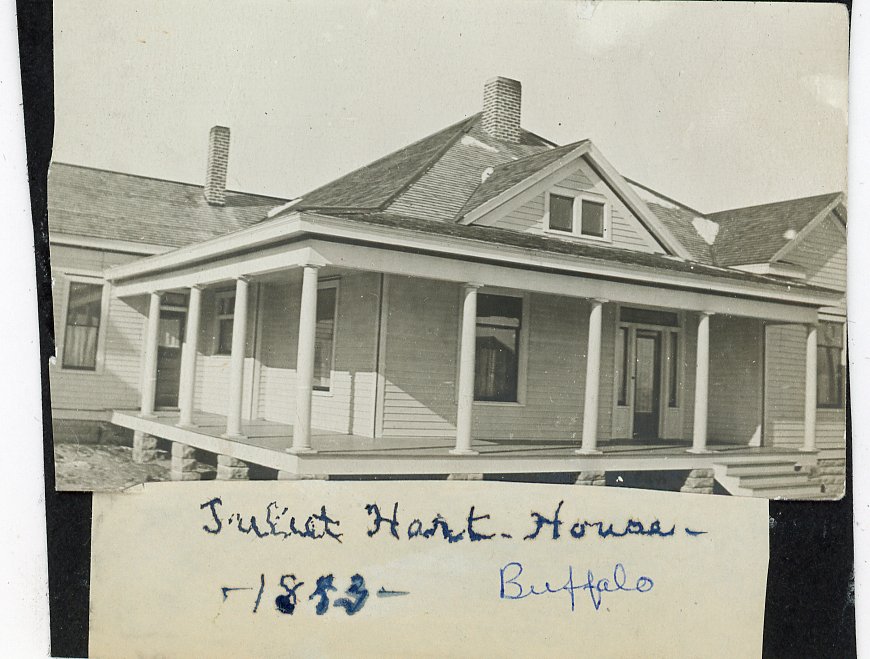
Juliet Hart's house...she was the widow of Major Verling Hart who had filed a Desert Claim on the land that is now Buffalo.
By Phil Roberts
The townsite of Buffalo was once almost
entirely owned by a widow. Her late husband had the foresight to file a
desert claim on the land while he was serving at nearby Fort McKinney in
the early 1880s.
The fort had been located in the summer of 1878
when the army moved a camp from the Powder River area to the banks of
Clear Creek. With the construction of the fort, civilians came in the
area to obtain contracts from the government for provisioning the new
post. Unable to stay on the military reservation, they established their
own camps along the creek east of the fort. Saloons were not allowed on
the military reservation so they sprung up just outside the boundaries,
too.
During the fall of 1879, August Trabing, who owned stores in
Medicine Bow, Laramie and other towns, moved his trading post from the
Powder River area to Buffalo. Soon after, he sold out to Joseph Conrad
and his partners. The next summer the first Occidental Hotel was
constructed and other buildings began to go up.
The story goes
that it was at this time that Main Street was laid out—in a most unusual
way. Joseph Conrad had noticed that wherever the bull team outfits from
the fort passed, a road would become established. He offered one
teamster, George Washbaugh, a new suit if he would alter his route
slightly and pass by the Conrad store. The curves in Main Street were
there to stay after Washbaugh took the detour past the store.
For
some inexplicable reason, builders failed to bother to purchase land on
which they built. Apparently, they didn’t even check to see who owned
the land. The buildings had been constructed on the desert claim of
Major Verling K. Hart, post commander at Fort McKinney, a Civil War
veteran who was breveted a major for his service in the battle of
Chicamauga.
Hart, who had become involved in mining investments
when he was commanding officer at Fort Laramie (and the namesake of the
town of Hartville on the site of one mine), had made the claim almost as
soon as he had arrived. The Indiana-born soldier died of a heart seizure
at the age of 44 the next year. His widow, Juliet W. Hart, became the
claim owner. A native of Michigan, Mrs. Hart was only 32 when her
husband died.
A controversy soon developed between Mrs. Hart and
the owners of the buildings that stood on her claim. Although the
details of the negotiations are unclear, the Carbon County Journal
reported on Sept. 29, 1883, that: “It is now thought that all the
trouble about the townsite of Buffalo is over, as Mrs. Hart has signed
the agreement drawn up by the citizens, in which she agrees to sell all
lots now occupied at $10 each. It is to be hoped that there will be no
more trouble in this direction.”
Mrs. Hart was granted the patent
on the land in June 1884 and, a month later, she platted the original
townsite of Buffalo. It was by then a flourishing town.
The
Johnson County deed records show almost 250 entries for sales of land by
Mrs. Hart to various Buffalo settlers in the next few years. One
interesting entry for August 1884 is the deed to the County
Commissioners for a piece of land where the Johnson County Courthouse
still stands. The sale price was $512.
Mrs. Hart stayed in
Buffalo for several years after her husband’s untimely death. She and
her three children may have moved to Fort Robinson, Nebr., about 1889.
Later, deeds list her as living in Lee County, Iowa, and Detroit,
Michigan. Even though she was absent, she continued to sell town lots in
Buffalo from time to time.
Her son gained fame as the first
Wyoming appointee to have graduated from West Point. Verling K. Hart,
Jr., born in 1871, in Kansas, had been brought to Wyoming when his
father was transferred to Wyoming in the late 1870s. Joseph M. Carey,
Wyoming’s territorial delegate to Congress, named the younger Hart to
West Point in 1889.
After service in the Spanish American War in
both Cuba and the Philippines, he returned to Wyoming in 1906 to serve
at Fort D. A. Russell. According to the West Point annual reunion book
of 1915, he was discharged from the army for disability in 1910. He
became a partner in a hotel enterprise in Cheyenne. He died in Cheyenne
June 20, 1914, and his body was buried in Lakeview Cemetery, Cheyenne.
(In 1930, his son, also Verling K. Hart, was listed in the U. S. Census
as living in Charlotte, N.C., but his name does not appear in records
after that).
Juliet W. Hart, former owner of the townsite of
Buffalo, died in Washington, D. C., on June 10, 1909. She was laid to
rest next to her husband in Oakland Cemetery, Keokok, Iowa.
If you have questions, contributions, or problems with this site, email:
Coordinator - Rebecca Maloney
State Coordinator: Rebecca Maloney
Asst. State Coordinator: Bob Jenkins
If you have questions or problems with this site, email the County Coordinator. Please to not ask for specfic research on your family. I am unable to do your personal research. I do not live in Wyoming and do not have access to additional records.